
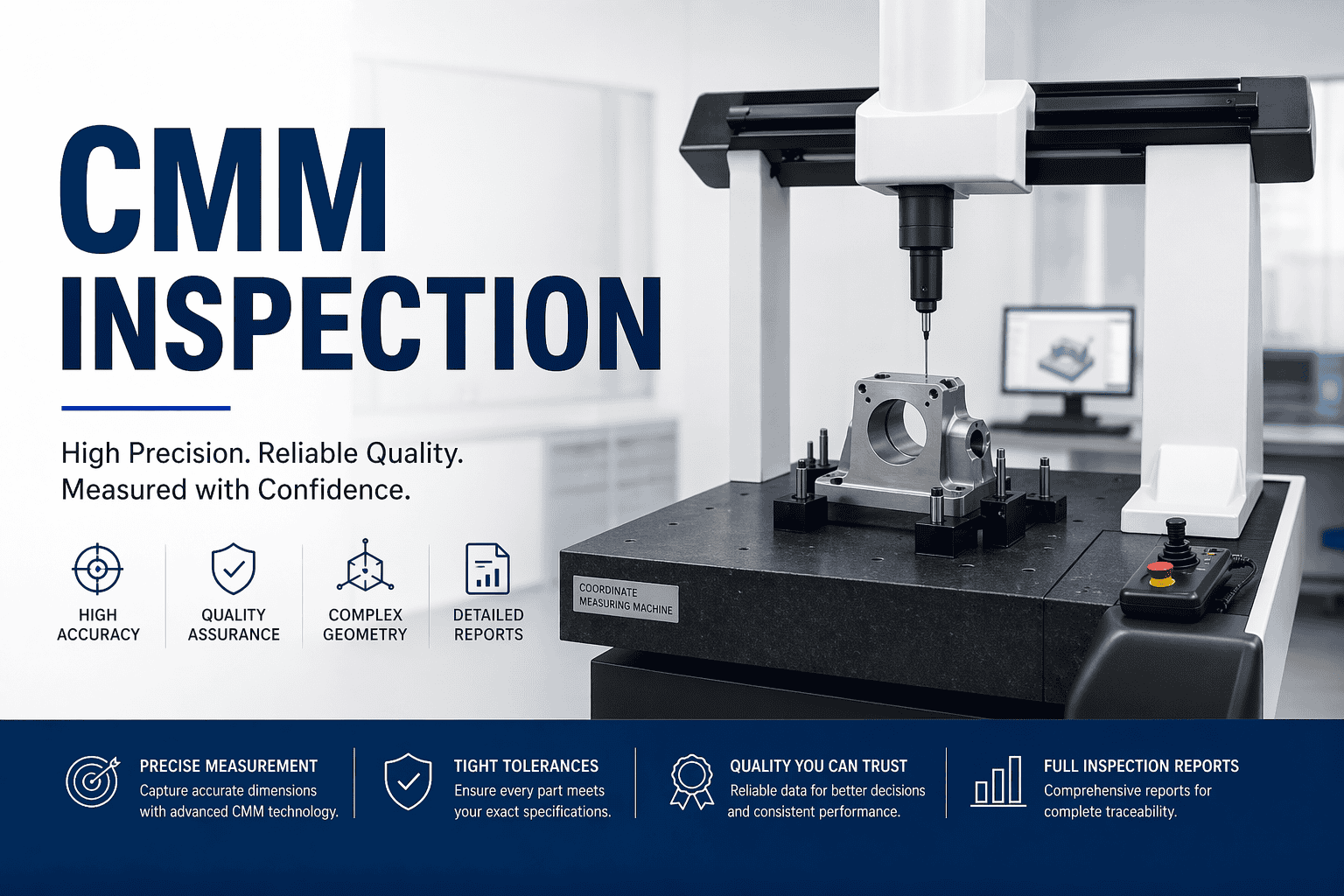
In modern manufacturing, precision is not just a technical requirement. As tolerances become tighter and customer expectations continue to rise, manufacturers need reliable ways to verify that every component matches its design. That is where CMM inspection becomes especially important.
CMM inspection is widely used in industries where dimensional accuracy matters, including automotive, aerospace, electronics, medical devices, and industrial equipment. It helps manufacturers measure complex parts with high precision, compare actual dimensions with CAD data, and identify deviations before products move further into assembly or shipment.
This article explains what CMM inspection is, how it works, what it is used for, and why it remains one of the most important quality control methods in precision manufacturing.
What Is CMM Inspection?
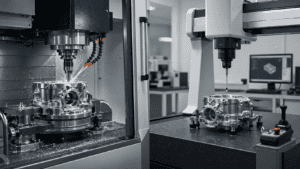
CMM inspection, or CMM dimensional inspection refers to the use of a Coordinate Measuring Machine (CMM) to measure the physical geometry of a part. The machine records points on the surface of an object and uses those points to determine dimensions, positions, angles, tolerances, and geometric relationships.
In simple terms, a CMM checks whether a manufactured part matches the intended design. It can verify hole positions, flatness, roundness, height, width, profile, and many other features that are difficult to evaluate accurately with manual tools alone.
Unlike a simple ruler or caliper, a CMM is designed for advanced dimensional inspection. It is especially useful when parts have complex shapes, tight tolerances, or multiple critical measurement points.
How Does CMM Inspection Work?
A CMM works by identifying coordinates in three-dimensional space. The machine uses a probe to touch or scan specific points on a part. These points are then analyzed by software, which calculates the dimensions and compares them with the nominal values from the drawing or CAD model.
The inspection process usually follows these steps:
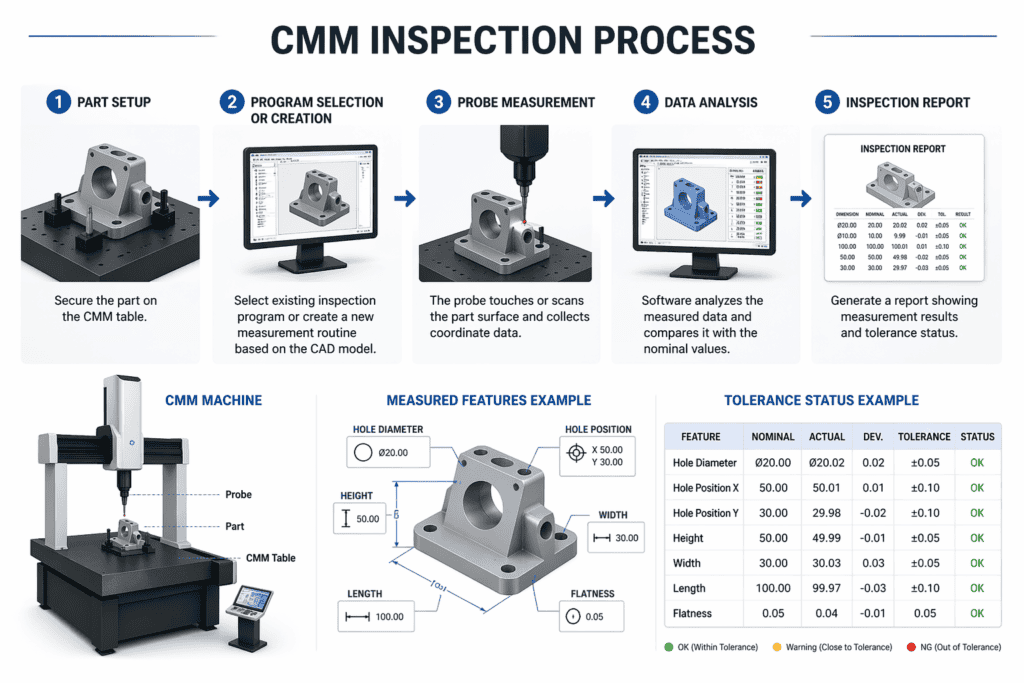
Part Setup
The part is fixed securely on the inspection table to prevent movement during measurement.
Program Selection or Creation
For repeat inspection, an inspection program may already exist. For new parts, the operator creates a measurement routine based on the drawing or 3D model.
Probe Measurement
The probe touches key surfaces or scans them automatically. The machine collects coordinate data from each selected point.
Data Analysis
Inspection software processes the measured data and compares it with the required dimensions and tolerances.
Inspection Report
A final report is generated, showing whether the part is within specification and identifying any out-of-tolerance features.
The above process allows manufacturers to inspect parts with a high level of consistency and repeatability.
What Parts Can Be Measured by CMM?
CMM inspection is suitable for a wide range of components. It is commonly used for:
- CNC machined parts
- die cast parts
- stamped metal parts
- molds and tooling
- aluminum components
- plastic parts
- assemblies with critical geometric features
It is particularly useful for parts with:
- tight tolerances
- multiple holes or mounting points
- curved or irregular surfaces
- GD&T requirements
- critical alignment or fit conditions
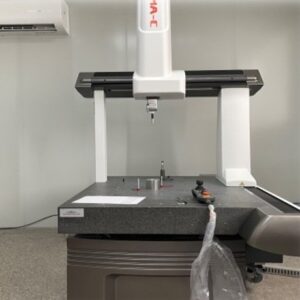
CMM Inspection and CNC Machining
CMM inspection is closely connected with CNC machining because machined parts often require strict dimensional control. Even when a CNC machine is highly accurate, inspection is still necessary to confirm that the final part matches the drawing.
For custom machined parts, CMM inspection can verify:
- overall dimensions
- hole spacing
- surface location
- concentricity
- flatness
- true position
- geometric tolerances
This makes it especially valuable for industries where precision matters, such as automotive, optical instruments, electronics, and industrial equipment.
CMM Inspection and Production Quality
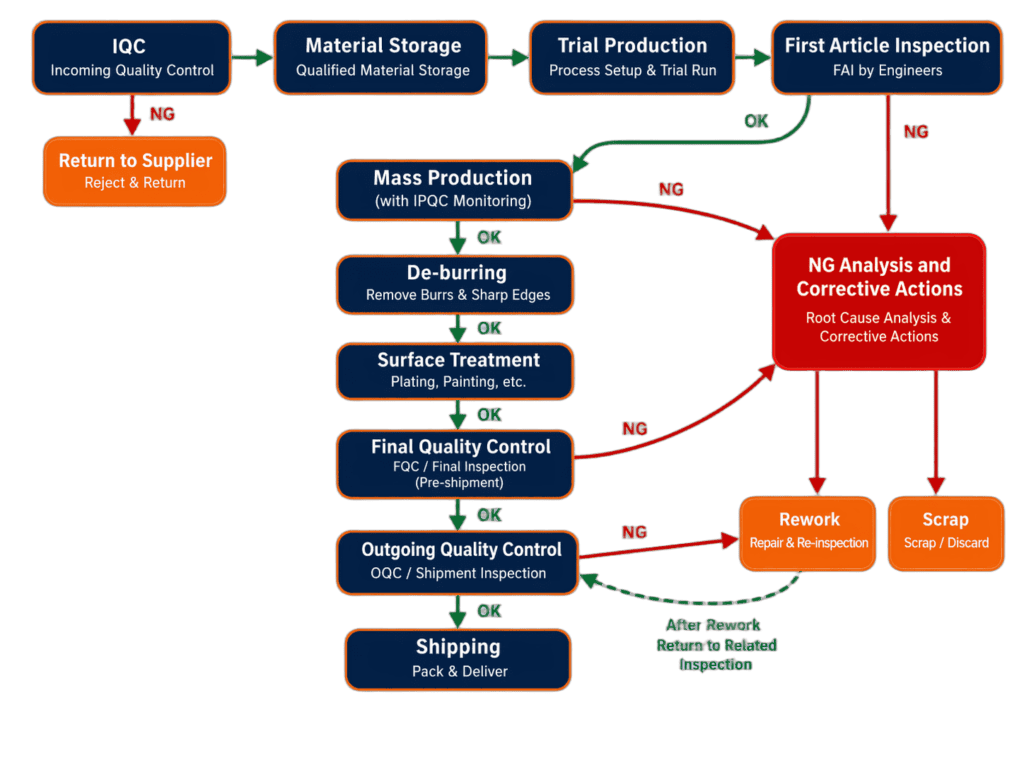
CMM inspection is not only a final inspection tool. It can also be used during production to support process control.
For example, manufacturers may use CMM inspection for:
- first article inspection
- in-process verification
- sample inspection during production
- final dimensional inspection
- validation of tooling changes
When used correctly, CMM inspection becomes part of a broader quality system rather than a standalone measurement step. It supports continuous improvement by turning dimensional results into usable process data.
Conclusion
CMM inspection is one of the most effective methods for verifying dimensional accuracy in modern manufacturing. By using coordinate-based measurement, it allows manufacturers to inspect complex parts with high precision and strong repeatability.
Whether used for CNC machined parts, die cast components, stamped parts, or custom industrial products, CMM inspection helps ensure that parts meet design requirements before they move to the next stage. It improves quality control, supports process improvement, and gives both manufacturers and customers greater confidence in the final product.
In a competitive manufacturing environment, accurate measurement is not optional. It is an essential part of delivering reliable quality. That is why CMM inspection continues to play such an important role in precision production.
What Can Our Firm Offer To You?
Kaitao Tech has been serving the manufacturing industry for over 25 years. We have supported customers across a wide range of industries, including automotive, optical instruments, and consumer electronics. In addition to our manufacturing capabilities, we also provide professional CMM inspection services to help ensure dimensional accuracy, consistent quality, and reliable inspection results. Committed to high standards in both production and quality control, we strive to deliver dependable products and excellent service to every customer. We look forward to building long-term cooperation and providing an outstanding customer experience.